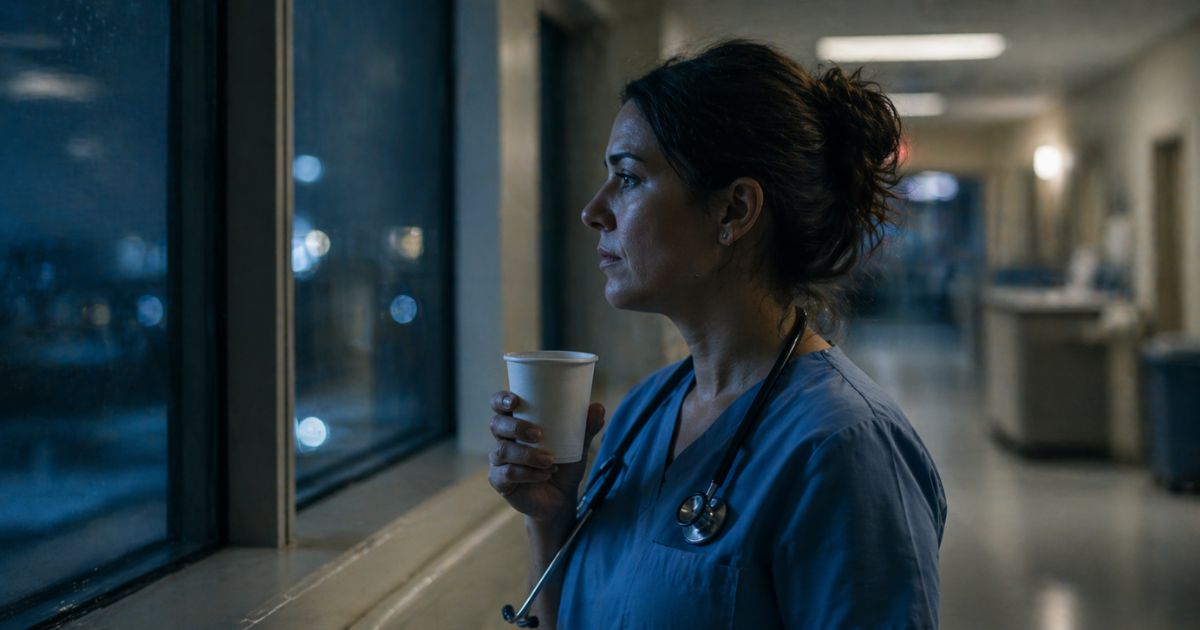
I'm not a nurse. I've never clocked a 12-hour shift in an ICU, never done a three-in-a-row night rotation, never had to chart vitals at 4am after sleeping four hours the day before.
But I've spent the last three years building a caffeine product, which means I've spent a lot of time talking to nurses. They buy Drizz. They tell me why. And the pattern across every conversation is the same: nurses don't have a caffeine problem — they have a timing problem, a dosing problem, and a sleep-debt problem that caffeine can't actually fix.
This guide pulls together what the research says, what nursing journals have published, and what I've heard directly from the RNs who use our product on shift. Consider it a starting point, not a prescription.
The direct answer
For most nurses on 12-hour shifts, the research supports three rules:
- Stay under 400mg of caffeine per day. That's the FDA's general guidance for healthy adults.
- Split the dose. Two or three smaller servings across the first 6–8 hours of your shift beat one large cup at clock-in.
- Cut off caffeine at least 6 hours before your target sleep window. A 2013 study in the Journal of Clinical Sleep Medicine found caffeine 6 hours before bed still costs over an hour of total sleep.
That's the frame. The rest of this post is how to apply it to day, night, and rotating shifts — and where the research gets murky.
Table of contents
- Why shift work breaks normal caffeine advice
- The three-shift reality
- Day-shift dosing (7am–7pm)
- Night-shift dosing (7pm–7am)
- Rotating shifts: the hardest case
- The crash and why L-theanine matters
- Practical tools for a 12-hour shift
Why shift work breaks normal caffeine advice {#why-shift-work-breaks-normal-caffeine-advice}
Most caffeine guidance assumes you sleep at night and work during the day. That's the baseline the FDA's 400mg/day figure is built around. It assumes your circadian rhythm is already doing the work of keeping you alert during daylight hours, and caffeine is a supplement on top.
Nurses don't get that baseline. According to the CDC's NIOSH training for nurses on shift work, more than 30% of registered nurses in the U.S. work non-daytime schedules. That means millions of healthcare workers are using caffeine not as a supplement to a normal sleep pattern but as a substitute for one.
This matters because caffeine's effects depend on what your body is already doing. A cup of coffee at 7am helps you align with your natural cortisol rise. A cup of coffee at 7pm on a night shift fights your circadian drive to sleep — which is why it works, and also why the crash afterward tends to hit harder.
The three-shift reality {#the-three-shift-reality}
Nursing schedules generally fall into three patterns:
- Day shift: roughly 7am to 7pm. Aligned with circadian rhythm. Caffeine behaves predictably.
- Night shift: roughly 7pm to 7am. Fights circadian rhythm. Caffeine timing is critical.
- Rotating or swing shifts: any mix of the above, often changing week to week. The body never fully adapts.
A 2017 paper in the journal Industrial Health found that rotating-shift nurses showed higher rates of sleep disruption and fatigue than either permanent day or permanent night workers. That's counterintuitive — you'd think rotating would let you "catch up" on normal nights. It doesn't. The body treats each transition like a mini jet-lag.
Each shift pattern needs its own caffeine approach. One size does not fit all.
Day-shift dosing (7am–7pm) {#day-shift-dosing}
Day shift is the most forgiving. Your circadian rhythm is working with you, not against you.
A reasonable pattern for a 12-hour day shift:
- 7am–8am: 80–100mg caffeine (roughly one cup of coffee or ~1.5 squeezes of a liquid drop).
- 11am–12pm: 60–80mg second dose if needed.
- Hard cutoff by 1pm: gives you a 6-hour runway before a 9pm wind-down.
Total: around 160–180mg per day. Well under the 400mg ceiling, split into two windows, and cut off early enough that sleep stays protected.
The mistake most day-shift nurses I've talked to make isn't quantity — it's that third cup at 3pm when the afternoon lull hits. A Mayo Clinic review on caffeine and sleep notes that afternoon caffeine is the single biggest correctable factor in adult sleep quality. If the 3pm slump is a daily event, the fix is usually more sleep the night before, not more caffeine.
Night-shift dosing (7pm–7am) {#night-shift-dosing}
Night shift is where timing becomes everything.
The challenge: you need to stay alert through the hardest circadian window (2am–5am) while preserving your ability to sleep when you get home at 8am. That's a narrow target.
A research-informed pattern for a 7pm–7am shift:
- 6:30pm (before clock-in): 80–100mg caffeine as you start your drive or commute.
- 10pm–11pm: 60–80mg second dose to bridge into the hardest hours.
- Absolute cutoff: 3am. If your sleep target is 9am, this gives you the 6-hour buffer the Journal of Clinical Sleep Medicine study flagged as the minimum.
The last four hours of a night shift — 3am to 7am — are the hardest to get through without caffeine, and they're also the hours where caffeine will cost you the most sleep. There's no clean answer. The best approaches I've heard from night-shift RNs: strategic short walks, cold water on the face, bright task lighting at the nursing station, and protein-based snacks instead of more coffee.
This is also where precision dosing becomes genuinely useful. A coffee machine at 2am gives you whatever ends up in the cup — could be 80mg, could be 150mg. Knowing you took exactly 65mg in a squeeze of water lets you plan backward from sleep instead of guessing.
Rotating shifts: the hardest case {#rotating-shifts-the-hardest-case}
If you rotate between days and nights on a weekly or biweekly schedule, your body never adapts. There's no "steady state" to build a caffeine routine around.
The research consensus from NIOSH's shift-work training is essentially:
- Treat each shift block as its own pattern. Don't try to apply night-shift rules to a day block or vice versa.
- Anchor caffeine to the first half of every shift, never the second half.
- Avoid using caffeine to compensate for chronic sleep debt. It doesn't work — it just delays the collapse.
A 2019 review in Sleep Medicine Reviews on shift-work sleep disorder found that workers who used caffeine reactively (whenever they felt tired) had worse long-term sleep outcomes than workers who used caffeine proactively (timed doses at the start of each shift). The proactive group wasn't consuming less — they were consuming smarter.
The crash and why L-theanine matters {#the-crash-and-why-l-theanine-matters}
The "caffeine crash" is real, but it's not a single mechanism. It's usually a combination of three things: blood sugar dropping after a sugary energy drink, adenosine rebound when caffeine wears off, and simple sleep debt catching up.
L-theanine, an amino acid found in green tea, doesn't prevent the crash — but published research suggests it smooths the ride. A 2008 study in Nutritional Neuroscience found that 97mg of L-theanine combined with 40mg of caffeine improved attention-switching accuracy and reduced self-reported tiredness compared to caffeine alone.
This is why green tea caffeine plus L-theanine shows up in a lot of "clean energy" formulas — including ours. Drizz uses green tea caffeine (not synthetic), adds L-theanine and taurine, and delivers 65mg per squeeze. The goal isn't to replace good sleep. It's to make each caffeine dose work a little cleaner so nurses aren't fighting jitters on top of fatigue.
For a deeper dive on the science, I've written more about caffeine and L-theanine in the green tea formula.
Practical tools for a 12-hour shift {#practical-tools-for-a-12-hour-shift}
Things I've heard repeatedly from nurses who've found a rhythm:
- Pre-dose in the car. Taking caffeine 20–30 minutes before clock-in means you hit the floor already alert, instead of chasing it after report.
- Keep the second dose small and predictable. A measured 65mg drop beats "however much coffee is left in the pot."
- Protect the cutoff time. Set a phone alarm. After 3am on a night shift, the answer is water, not caffeine.
- Carry something TSA-compliant if you travel between shifts. A 2oz bottle fits in scrubs pockets and doesn't require a break room detour. This is honestly why a lot of travel nurses ended up buying Drizz Boost Energy Drops — it slots into an existing water bottle instead of being a separate stop.
The real takeaway isn't "drink Drizz." It's that most nurses I've talked to were treating caffeine as a reactive tool — something to grab when the wall hits. The ones who felt better, slept better, and lasted longer in the profession had all done the same thing: they'd built a dosing plan and stuck to it.
That's it. Timing, dose control, protected sleep window. Caffeine is a tool, not a strategy. The strategy is sleep.
These statements have not been evaluated by the Food and Drug Administration. This product is not intended to diagnose, treat, cure, or prevent any disease. Consult your doctor before starting any new supplement, especially if you are pregnant, nursing, or have a medical condition.